
Flow and thermal analysis (CFD): seeing what air and fluids actually do.
Computational fluid dynamics for flow and heat-transfer problems that are hard to understand from intuition or simplified calculations alone.
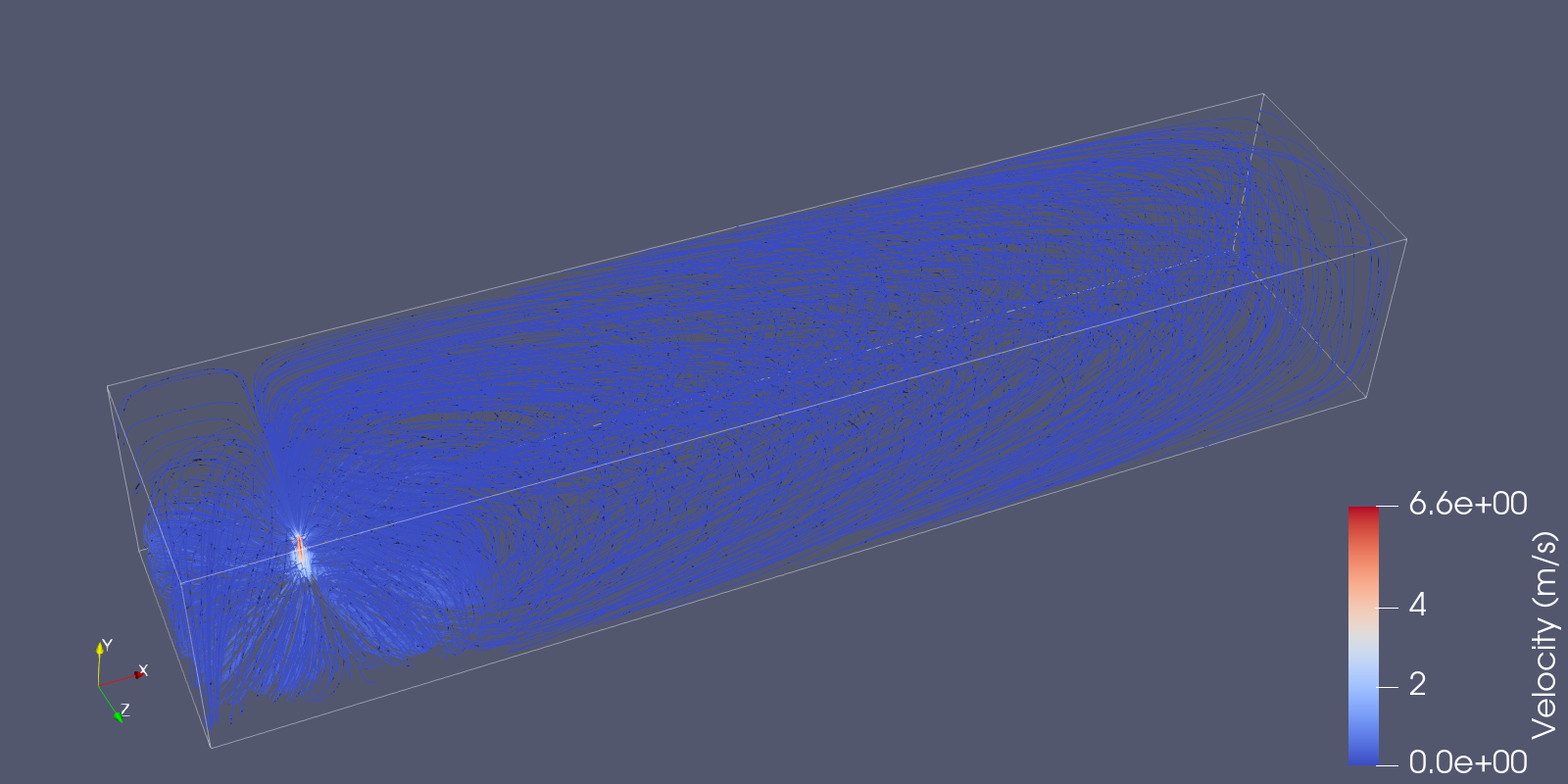
What a CFD study is usually asked to answer.
- What flow rate and pressure head does the system require?
- Where are the major pressure losses?
- How is the fluid distributed through the system?
- Are there regions of recirculation or unfavourable flow?
- How does a geometry change affect the flow?
- How can cooling or ventilation be improved?
- How does air move through a space?
- What aerodynamic loads may act on a structure?
- How do operating conditions influence performance?
Depending on the application, CFD may cover:
- Velocity and pressure fields
- Flow distribution
- Pressure losses
- Recirculation
- Heat transfer
- Temperature distribution
- Natural and forced convection
- Ventilation patterns
- Aerodynamic forces
- The influence of geometry and operating conditions
CFD is particularly useful when the flow is not adequately described by a single average velocity, pressure or flow rate.
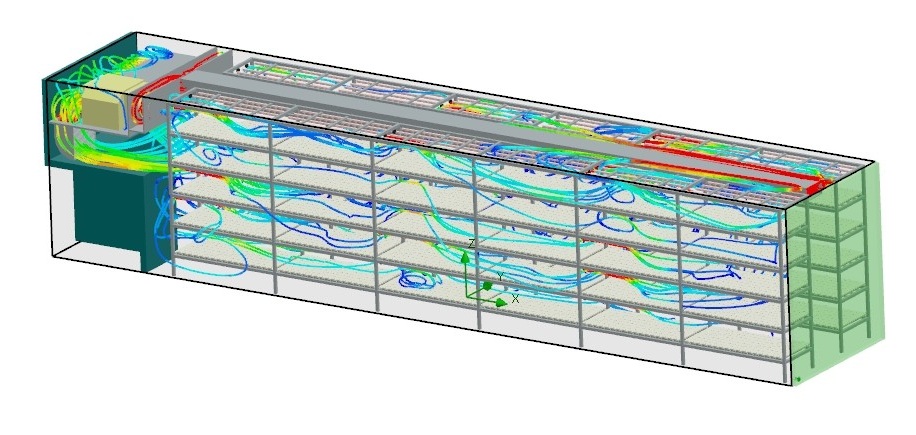
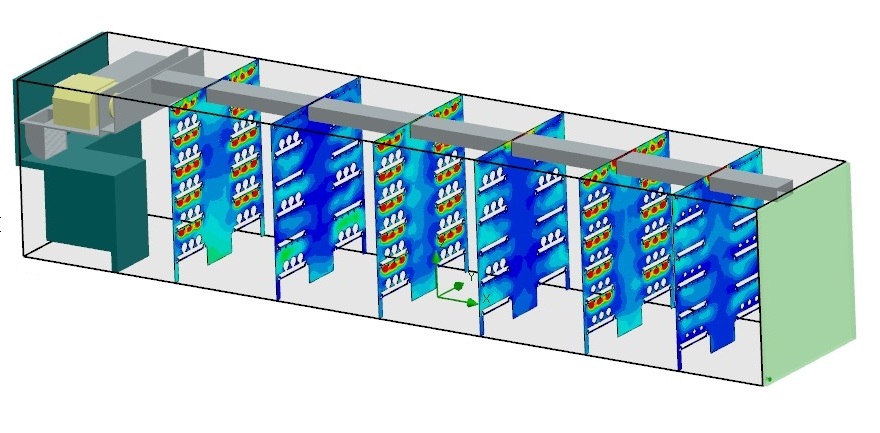
Professional flow analysis, without enterprise licence costs.
Commercial CFD packages often cost thousands of euros a year per seat, and that cost ends up in the price of every study. We work with a mature open-source toolchain instead, so an SME pays for engineering time, not for software licences.
The solver, OpenFOAM, is one of the most widely used CFD codes in industry and research. It covers the flow and thermal problems most industrial questions involve:
- Steady and transient flow
- Turbulent flow
- Pressure losses and flow distribution
- Heat transfer
- Natural and forced convection
- Ventilation and airflow in spaces
- Aerodynamic forces on structures
Honest about the limits
Where a question genuinely needs a feature that only a commercial package offers, we say so before the work starts.
The workflow
-
Geometry: FreeCAD
The fluid domain is built from the CAD model, with details removed where they don't affect the flow.
-
Mesh: Netgen
The domain is meshed, with refinement near walls, openings and wherever the flow changes quickly.
-
Solution: OpenFOAM
Physical models and boundary conditions are set, each assumption is recorded, and convergence and sensitivity are checked.
-
Post-processing: ParaView
Velocities, pressures and temperatures are extracted and presented as streamlines, sections and figures for the decision.
This offering is not approved or endorsed by OpenCFD Limited, producer and distributor of the OpenFOAM software via www.openfoam.com, and owner of the OPENFOAM® and OpenCFD® trade marks. Other product names are trademarks of their respective owners.
Start from the system, not from the model.
-
Understand the system
Specifications, operating conditions, measurements and history. Many flow problems are settled at this stage with calculations.
-
Define scenarios
Which operating points or environmental conditions matter for the decision, and which can be left out.
-
Build and check the model
Geometry simplification, mesh, physical models and boundary conditions, with convergence and sensitivity checks.
-
Compare alternatives
Geometry or layout changes evaluated side by side, so the effect of each change is clear.
-
Report and recommend
What to change, what the limits of the result are, and which measurements would confirm it.
What you receive
- A concise report: question, scenarios, assumptions, results, limits
- Flow and temperature visualisations that explain the behaviour
- Side-by-side comparison of design alternatives
- Concrete recommendations for geometry, layout or equipment
Defined scenarios, stated limits
CFD answers the scenarios it is given. Real conditions vary, so results are presented with their assumptions, and measurements are recommended where the decision depends on them.
Results that are useful, transparent and properly qualified.
Every model requires decisions about:
- What should be included, and what can be simplified
- Which loads and operating conditions are realistic
- Which material properties are relevant
- Which boundary conditions represent the real application
- Which physical phenomena matter
- How the results should be interpreted
These decisions often matter more than the ability to produce a sophisticated-looking model, and they are where 35 years of industrial experience count.
Depending on the project, our work includes:
- Clearly defining the engineering question
- Documenting assumptions and input data
- Checking mesh quality and numerical behaviour
- Investigating sensitivity to important assumptions
- Comparing with hand calculations or known behaviour
- Stating limitations and uncertainties
- Distinguishing an engineering assessment from formal certification
- Recommending physical tests or measurements when needed
A simulation result should never be presented as more certain than the model and the input data justify.
Where CFD fits into a wider investigation
Discuss your engineering problem.
Tell us what you are developing, changing or trying to fix. We first look at the engineering question, then say plainly what is worth doing: a calculation, a design review, a test, a simulation, or a combination.