I'm designing a new product

Strength and Performance Analysis

Before the product is made, we need to know how it will behave. We use FEA and CFD when they are really needed, so that the analysis leads to a specific design decision.

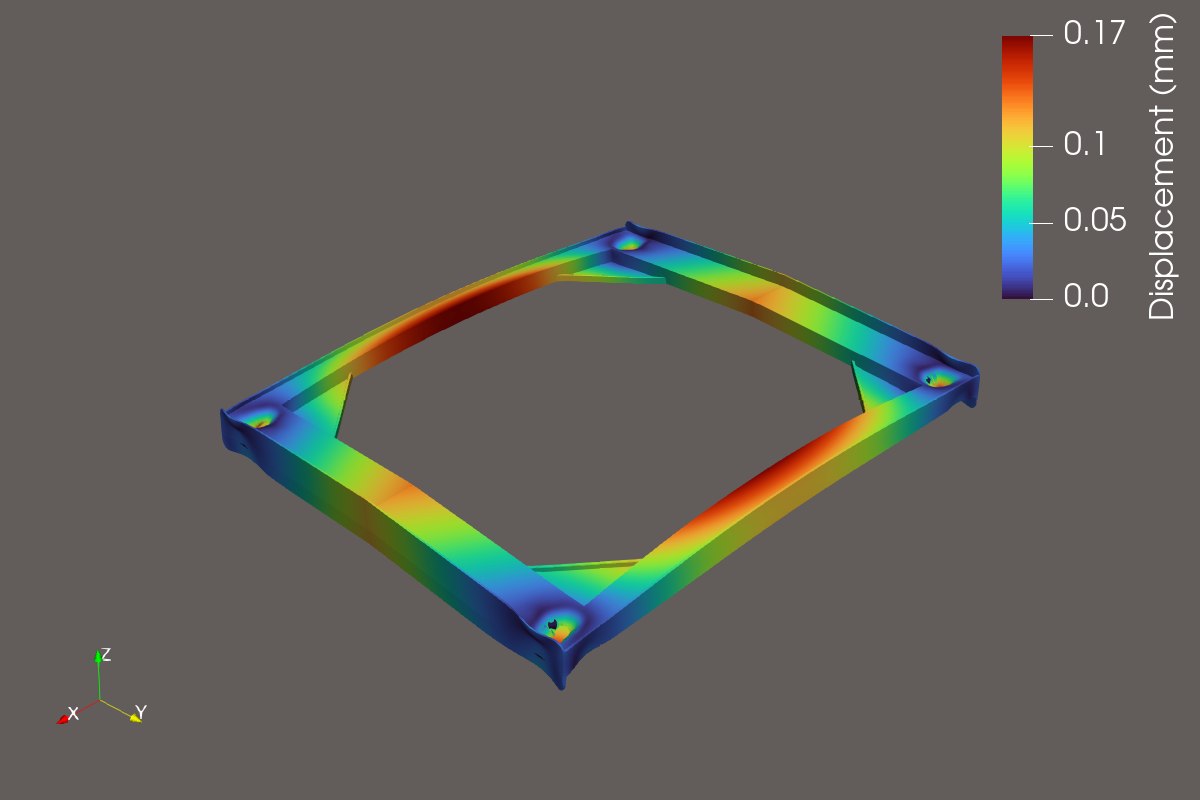
FEA displacement result on a supporting frame, post-processed in ParaView
The engineering question first

Analysis when it adds value, not simulation for its own sake.

A colourful result is easy to produce. The hard part is knowing which question the analysis has to answer, which loads and conditions are realistic, and what the result means for the design.

Many questions are settled with a hand calculation or a test. We say so, and we use FEA or CFD only where they lead to a better decision: a thinner wall, a reinforcement in the right place, a different layout.

Typical questions

  • Is this part strong and stiff enough, and where are its limits?
  • Can material be removed without losing performance?
  • Which components are affected by a higher load?
  • Where are the major pressure losses in the system?
  • How does air move through a space or around a structure?
FEA · Finite element analysis

How a part or assembly really behaves under load.

Finite element analysis of plastic and metal parts and assemblies. Depending on the question it covers:

  • Stress and strain
  • Displacement and stiffness
  • Contact between parts
  • Large deformations, where supported
  • Buckling
  • Natural frequencies
  • Reaction forces
  • Drop test
The purpose is not simply to calculate a stress value. It is to understand how the component behaves, where its limits may be, and which design decisions are worth investigating.
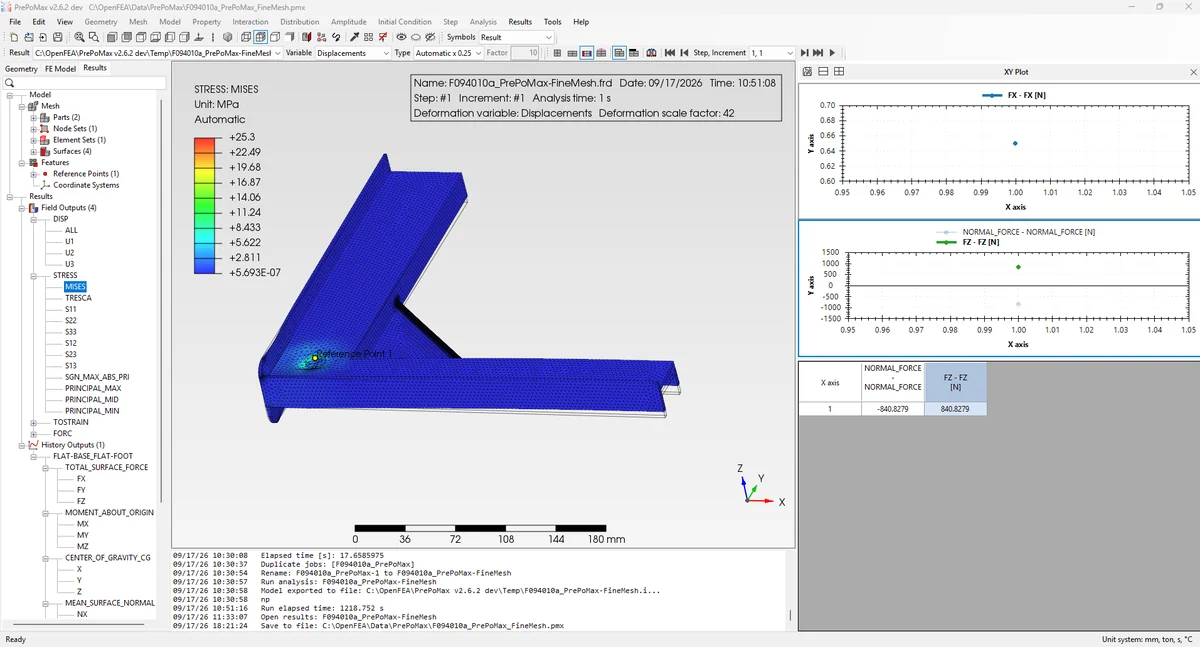
Von Mises stress result on a profile corner joint in PrePoMax, with force plots
Static stress on a profile corner joint, in PrePoMax. The useful reading is where stress concentrates and why, not the peak number on its own.
CFD · Computational fluid dynamics

What air, gases and liquids actually do.

CFD is useful when the flow is not adequately described by a single average velocity, pressure or flow rate. Depending on the application it covers:

  • Velocity and pressure fields
  • Pressure losses
  • Flow distribution
  • Recirculation and stagnant zones
  • Air and gas flow in spaces
  • Flow around parts
  • Aerodynamic forces
  • The effect of a geometry change
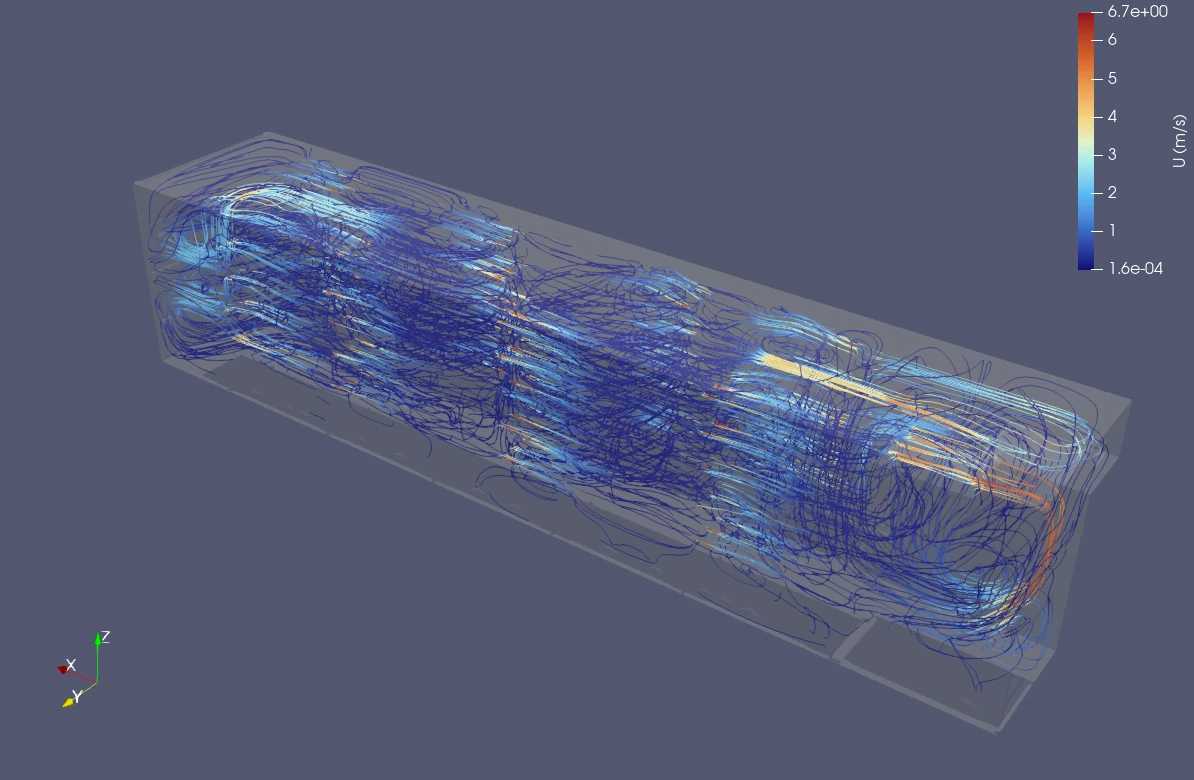
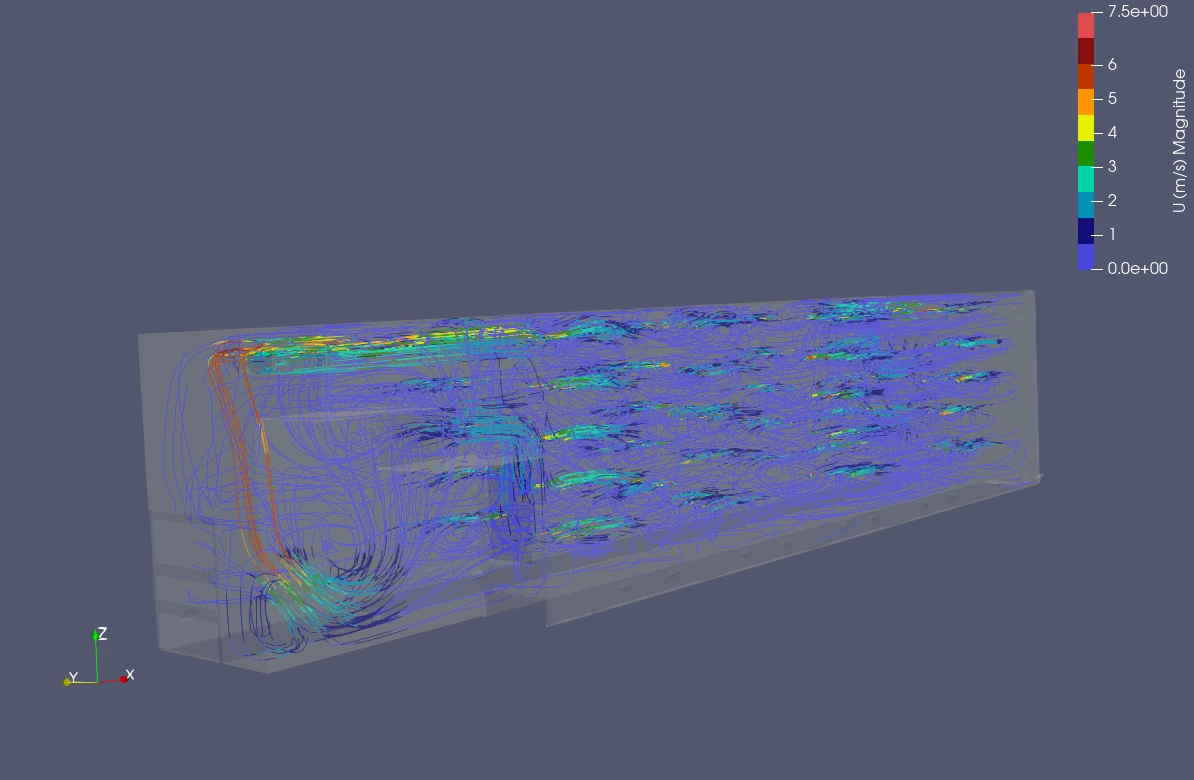
Airflow streamlines from the air handling unit through the cultivation racks
Streamlines in a container laboratory. Colour shows velocity, so slow and stagnant zones are visible at a glance.
How we work

From the question to a decision you can act on.

  1. Define the question

    What decision the analysis supports, and whether FEA or CFD is the right tool or a calculation will do.

  2. Realistic inputs

    Geometry, materials, loads, supports and operating conditions, with every assumption written down.

  3. Build and check the model

    Mesh, convergence, sensitivity to the key assumptions and comparison with hand calculations.

  4. Interpret for manufacturing and use

    What the results mean for wall thickness, ribs, material, layout and cost, not just colours on a model.

  5. Report and recommend

    Findings, limits and a clear recommendation, including physical tests where they are needed.

What you receive

  • A concise report: question, assumptions, results, limits
  • Annotated result images that explain what matters
  • Comparison of design alternatives, when requested
  • Concrete design recommendations

What we do not do

  • Formal certification: an analysis is an engineering assessment under stated assumptions
  • Laboratory testing in-house; where tests are needed, we specify them and work with a suitable laboratory
  • Analysis without a clear engineering question

Open-source tools, no licence costs

Commercial FEA and CFD packages cost thousands of euros a year per seat, and that cost ends up in every study. We work with mature open-source solvers (CalculiX for FEA, OpenFOAM for CFD), so you pay for engineering time, not for licences. Where a question genuinely needs a commercial package, we say so before the work starts.

This offering is not approved or endorsed by OpenCFD Limited, producer and distributor of the OpenFOAM software via www.openfoam.com, and owner of the OPENFOAM® and OpenCFD® trade marks. Other product names are trademarks of their respective owners.

A responsible approach

Results that are useful, transparent and properly qualified.

Every model requires decisions about:

  • What should be included, and what can be simplified
  • Which loads and operating conditions are realistic
  • Which material properties are relevant
  • Which boundary conditions represent the real application
  • Which physical phenomena matter
  • How the results should be interpreted

These decisions often matter more than the ability to produce a sophisticated-looking model, and they are where 35 years of industrial experience count.

Depending on the project, our work includes:

  • Clearly defining the engineering question
  • Documenting assumptions and input data
  • Checking mesh quality and numerical behaviour
  • Investigating sensitivity to important assumptions
  • Comparing with hand calculations or known behaviour
  • Stating limitations and uncertainties
  • Distinguishing an engineering assessment from formal certification
  • Recommending physical tests or measurements when needed
A simulation result should never be presented as more certain than the model and the input data justify.
Related projects

Real projects.

Product engineering

A 3-axis gimbal for serial production

Parts designed for injection moulding, checked with FEA before tooling is committed.
See the project

CFD · Mechanical design

A hydroponic laboratory in a container

The airflow corrected with CFD before construction.
See the project

All projects: FEA

Do you have an engineering question? Let's discuss it.

Tell us what you need to decide and what you already know: geometry, materials, loads, operating conditions. We will tell you plainly whether a calculation, an analysis, a test or a combination is worth doing.
Complimentary first site visit & analysis Custom proposal, regardless of project scale Strict confidentiality & NDA protection